
·CASE STUDY
CLIENT
SCOPE
PLATFORMS CONSOLIDATED
THE BRIEF
Rebrand the Censored Planet platform.
Censored Planet is a research lab at the University of Michigan studying global internet censorship through large-scale remote measurement. Its work informs journalists, policymakers, and civil society organisations. The brief was a full rebrand — a new visual identity to reflect the lab's expanding scope.
THE FRAGMENTATION
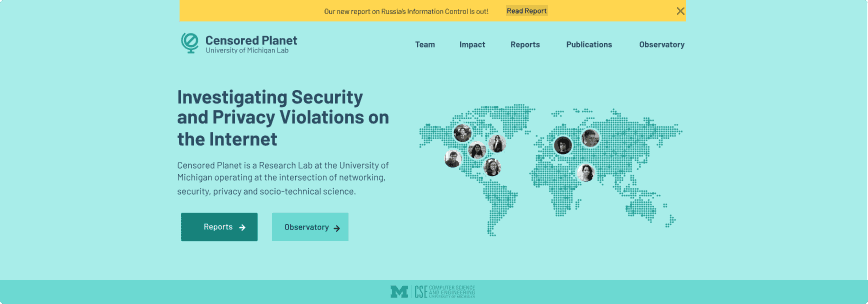
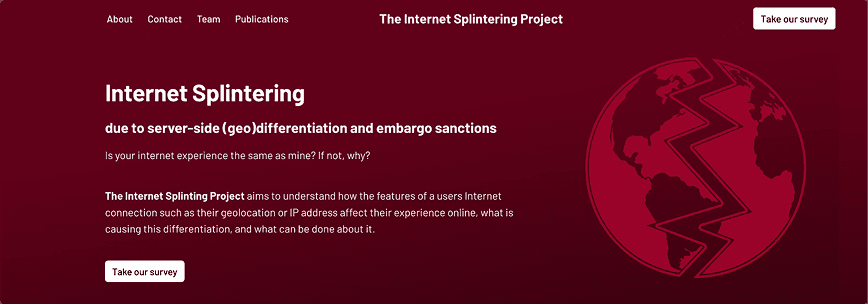
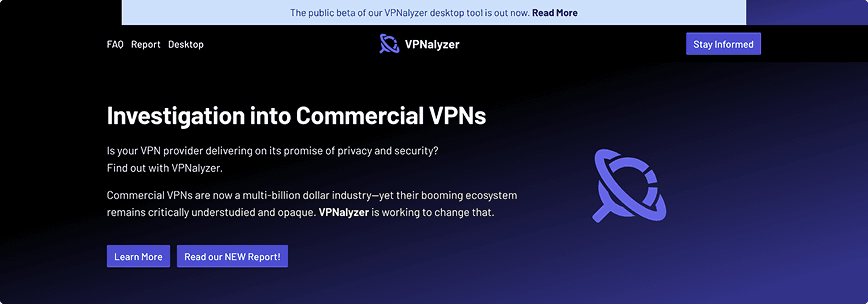
The lab's work lived across three separate sites — the Censored Planet Observatory, the Internet Splintering Project, and VPNAnalyzer. Each had its own visual identity, its own navigation, its own audience. To anyone arriving from the outside, they looked like three unrelated projects rather than three faces of the same research group. The brief asked for a rebrand of one. The actual problem was that there were three.
CENSORED PLANET OBSERVATORY
INTERNET SPLINTERING PROJECT
VPN ANALYZE
THE SCOPE NEGOTIATION
A rebrand would solve the wrong problem.
Preliminary research before the kickoff made the situation clear: the visual design wasn't the primary problem. The structure was. A rebrand applied to three independent sites would have produced three better-looking sites that still worked as three. The lab's audiences wouldn't have noticed the difference.
The kickoff opened with a different proposal: restructure and refresh, not rebrand. Consolidate the three sites into one. Rebuild the navigation around audience needs. Update the visual design within the existing identity rather than starting from scratch. Better use of the available resources, much bigger impact. The client agreed.
ORIGINAL BRIEF
Full rebrand — new visual identity across the platform
New logo, new visual language, new design system. Would have addressed how the lab looked without addressing how the lab was understood.
REVISED SCOPE
Restructure and refresh — fix the architecture first
Consolidate three sites into one. Rebuild navigation around audience needs. Refresh the visual design within the existing identity. Make the platform work for a much wider audience.
THE AUDIENCE SHIFT
Censored Planet investigates how governments and ISPs restrict access to information. That work matters far beyond the research community. But the existing platform was dense and academic — it assumed familiarity with the tools, the methods, and the language of the field. Arriving without that background meant leaving without understanding what the lab did or why it mattered. The redesign needed to make the work legible to everyone the research was meant to reach.
01
Researchers
02
Funders
03
Journalists
04
Students
05
Policymakers
THE ARCHITECTURE
The existing structure had grown around the projects that produced the content. Each site organised itself around its own tools and outputs, leaving no place for someone to step back and understand what the lab actually did. Visitors couldn't tell whether the work was research, tool development, or reporting — even though it was all three.
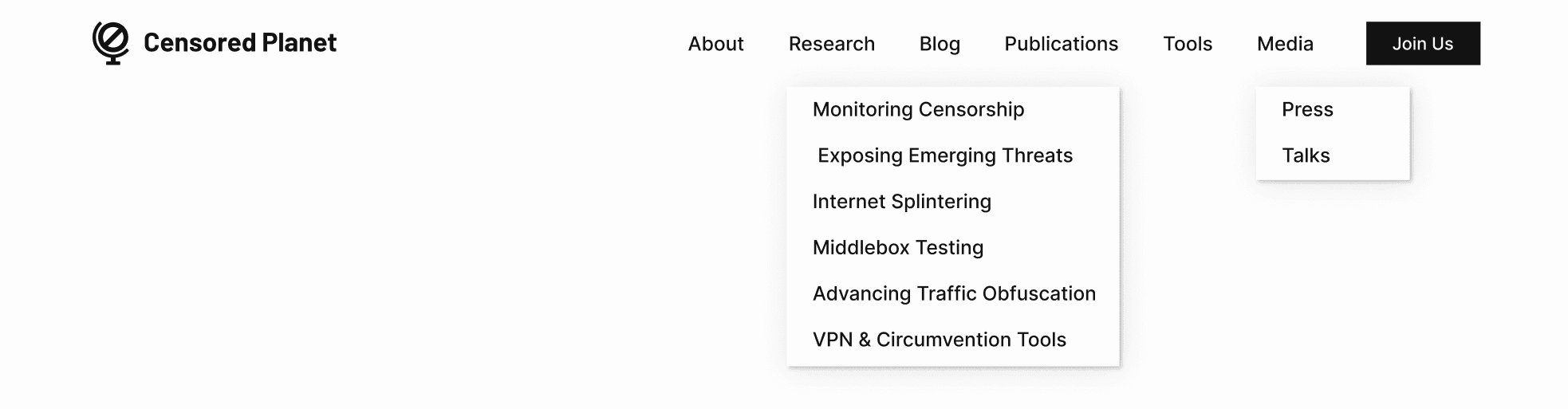
The new structure replaced that with five categories built around audience intent: About, Research, Tools, Media, and Contact. Content was inventoried, merged where it overlapped, and cut where it confused the narrative. The framework wasn't elaborate. It was simply built to answer the questions visitors actually arrived with.
Tree testing with participants drawn from across the audience groups validated the structure before any visual design began.
FINAL ARCHITECTURE
HOMEPAGE
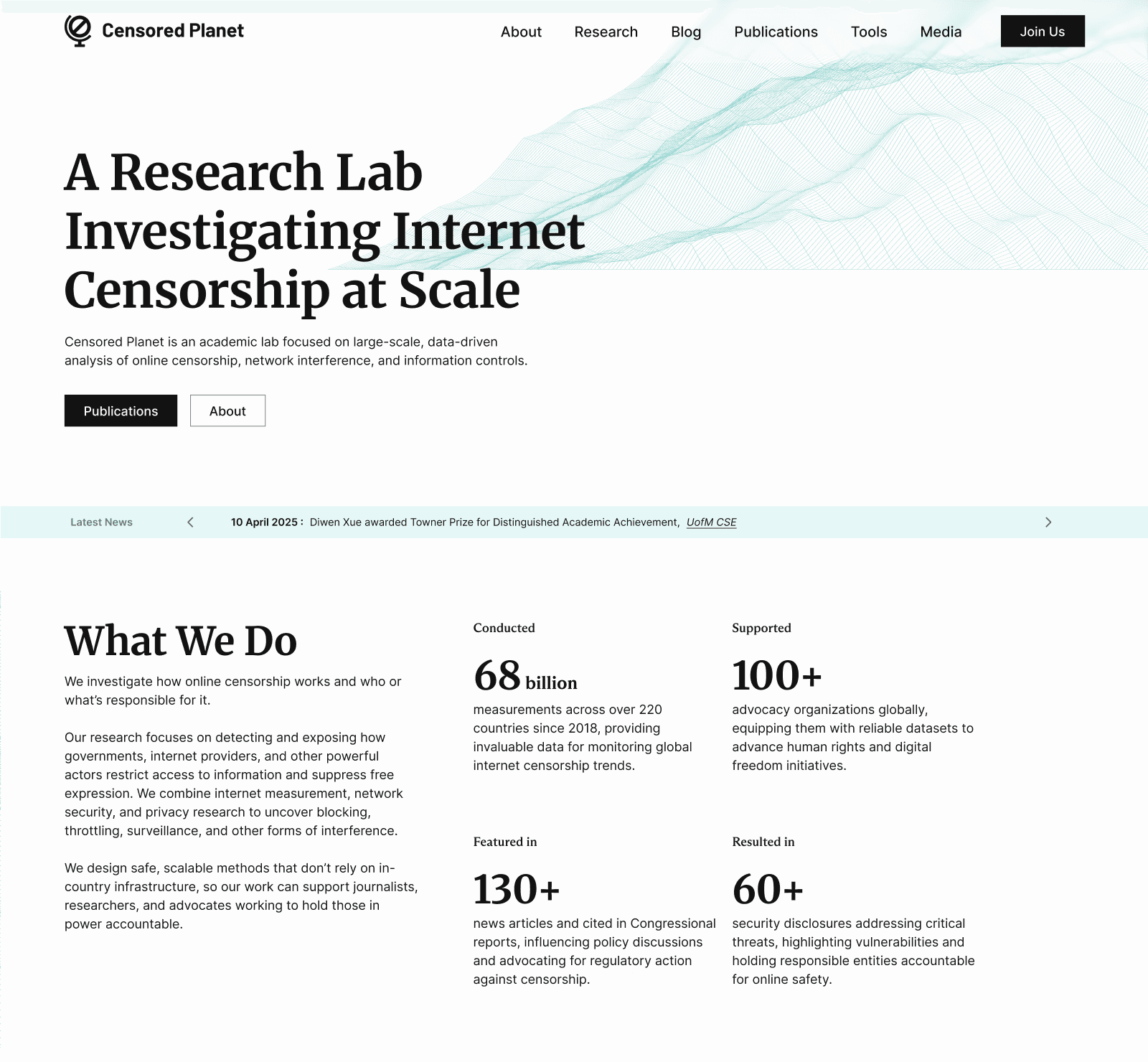
Rewriting every page on the platform wasn't feasible with the available budget. So the homepage was designed to do disproportionate work a single page that, by the time a visitor reached the bottom, gave them enough understanding of the lab to know where to go next. The architecture decided where things lived; the homepage made that architecture legible to people who didn't already know the lab existed.
The structure moved from broad to specific: a statement of mission, a plain-language summary of what the lab does, the questions it's investigating framed in audience-friendly language, the open-source tools that power the work, and the major research projects. Each section was written in the same voice plainspoken, focused, serious without being alarmist. Where the original platforms assumed familiarity with network security, the new homepage assumed only that a visitor was curious enough to scroll.
BEFORE
HERO TEXT
An Internet-wide Longitudinal Censorship Observatory
RESEARCH AREA
Active Probing of Geofencing
SECTION HEADING
Projects
SECTION DESCRIPTION
we design and deploy scalable techniques and systems to detect and protect users’ internet expereince from censorship, geo-discrimination, surveillance and various other internet freedom violations.
AFTER
HERO TEXT
A Research Lab Investigating Internet Censorship at Scale
RESEARCH AREA
Exposing Emerging Censorship Threats
SECTION HEADING
What we're investigating
SECTION DESCRIPTION
The internet is changing fast. We're investigating censorship systems to shed light on how they operate and who they affect.